
How to Choose an Auction Software Development Partner: 7-Point Checklist
A buyer's checklist for choosing an auction software development partner: the seven checks to run, questions to ask on the first call, and the red flags that cost projects months.
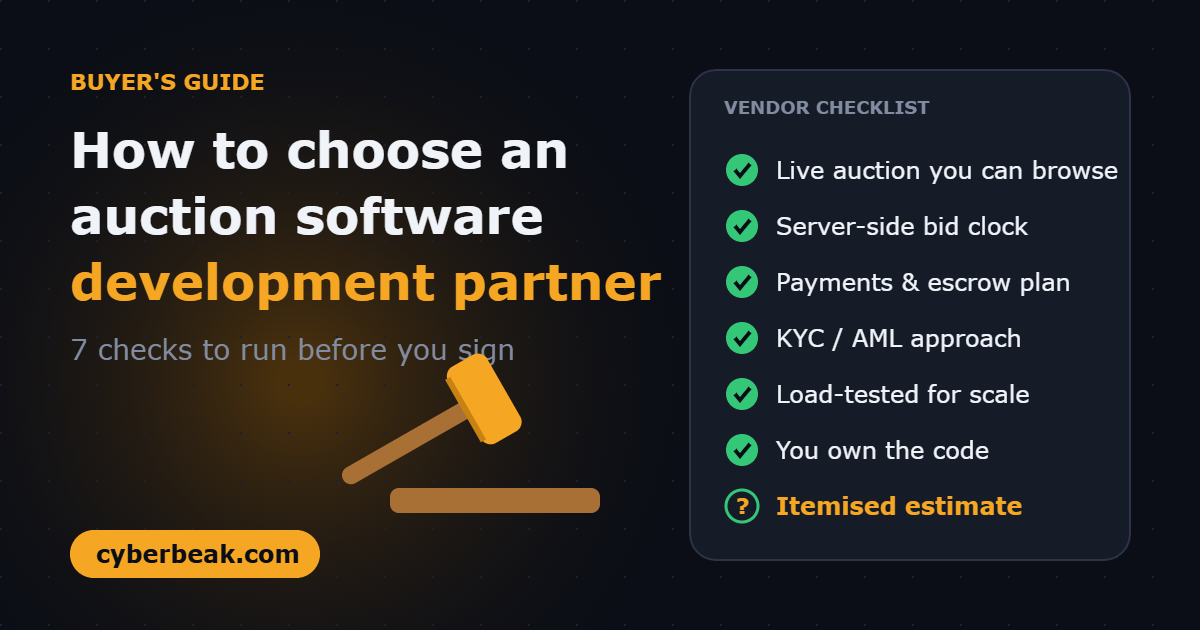
Short answer: choose the team that can show you a live auction platform handling real bids, explain how it prevents race conditions in the closing seconds, and put its payment, KYC and settlement approach in writing before you sign. Price, portfolio polish and years in business matter less than those three proofs.
This guide is for founders, auction houses and operators about to hire a software partner. It is a checklist you can use to compare any vendor, including us.
Why auction software is different from a normal web build
An auction platform has to be right at the moment of highest pressure. Many bidders act in the same few seconds, the clock must be authoritative on the server, and money moves afterwards. A team that has only built catalogue or shop sites often underestimates this. For the engineering detail, read our guide to real-time bidding architecture and the auction platform post-mortems.
The seven checks
1. Live proof
Good: a running auction platform you can browse, with a client willing to talk to you. Red flag: only screenshots and mock-ups.
2. Bidding integrity
Good: a server-side clock, atomic bid acceptance and clear rules for last-second bids. Red flag: "the front end handles the timer".
3. Money flow
Good: a written plan for payments, escrow or direct settlement, refunds and reconciliation. Red flag: payments described as "a plugin we will add later".
4. Identity and compliance
Good: a KYC and AML approach that fits your regions and transaction sizes (see our guide to KYC and payments for auction platforms). Red flag: no answer on regulation.
5. Scale plan
Good: a clear account of how the system behaves with thousands of simultaneous bidders and how it will be load-tested. Red flag: no load testing in the plan.
6. Ownership
Good: you own the code and the data, with a clean hand-over and documentation. Red flag: the vendor keeps the repository.
7. Commercials
Good: a fixed scope for phase one, an itemised estimate and a clear change process. Red flag: a single lump sum with no breakdown.
Questions to ask in the first call
- Which auction formats have you shipped: timed, live, sealed bid, reserve, proxy bidding?
- What was your hardest bidding incident, and what did you change afterwards?
- How do you prevent two bids being accepted at the same instant?
- Who handles identity verification and payments, and what are the failure cases?
- What will the first release include, and what is deliberately left out?
- Who will actually work on my project, and can I meet them?
- What does support cost after launch?
Compare vendors on the same scope
Ask each vendor for the same written scope and compare their answers to the seven checks above. To get a realistic budget before you talk to anyone, read our auction platform development cost guide and the technical guide to building an online auction platform.
Where Cyberbeak fits
Cyberbeak specialises in auction platforms, marketplaces and enterprise SaaS, and has worked on auction and bidding platforms for real clients. We are not the right fit for every project: if you need a simple catalogue site or a template shop, a hosted tool will be cheaper. If you need a custom bidding system with payments and compliance built in, talk to us and we will show you what we have built and where we would push back on your scope.
Parlez à notre équipe de votre projet
Nous travaillons avec des entreprises au Royaume-Uni, aux États-Unis, aux Émirats, en Arabie Saoudite, au Canada, en Australie et en Allemagne pour concevoir des logiciels sur mesure, des plateformes SaaS et des systèmes marketplace.